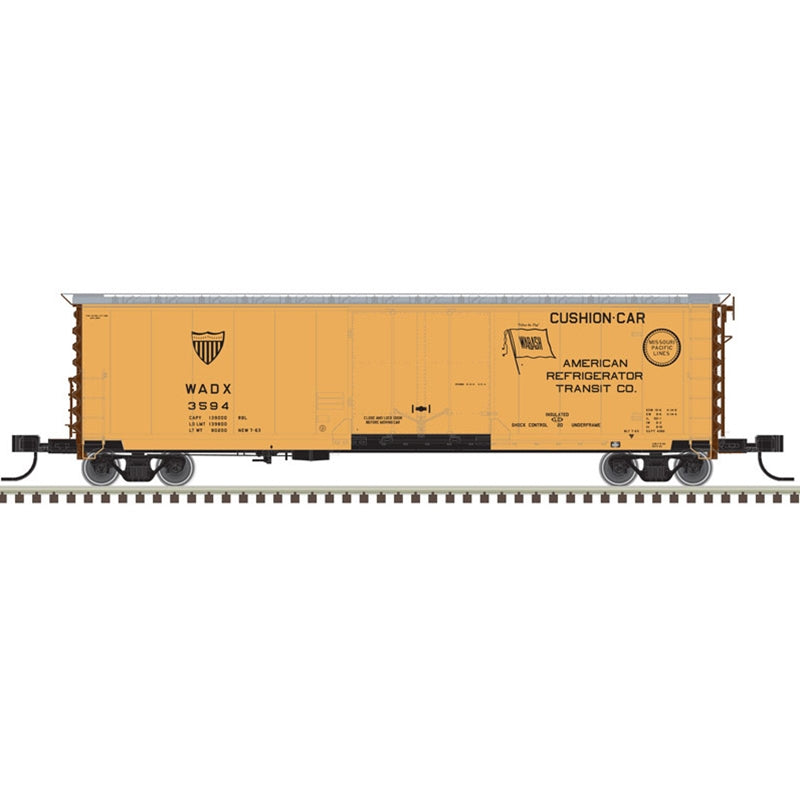
Atlas, 50 006 353, N Scale, 50' Precision Design rib-side Boxcar, Burlington Northern Santa Fe, #723016
- Low stock - 2 items left
ACF 50' Precision Design Rib-Side Boxcar - Ready to Run - Master(R)
🚂 50' ACF Precision Design Rib‑Side Boxcar — Detailed Explanation
In short:
The 50' ACF Precision Design rib‑side boxcar is a freight car built by American Car & Foundry (ACF) in the late 1960s and early 1970s, designed as a modern, standardized, and more durable boxcar for general merchandise service. It came in both rib‑side and smooth‑side versions, with the rib‑side being the more visually distinctive.
📌 Prototype Background
• Built by ACF beginning in the early 1960s, with most rib‑side versions produced in the late ’60s–early ’70s.
• Part of the industry shift toward:
• safer freight cars
• stronger underframes
• cushioned loading protection
• standardized components
• Many were built without roofwalks after the 1966 FRA safety regulations.
🧱 What “Precision Design” Means
“Precision Design” was ACF’s marketing term for:
• improved construction techniques
• tighter tolerances
• stronger, more durable side panels
• better draft gear and cushioning
• more efficient loading/unloading features
The rib‑side version used external vertical ribs to strengthen the carbody while keeping weight down.
🔍 Key Features of the Rib‑Side Version
1. Exterior
• Distinctive vertical external ribs for structural strength.
• 50'–50'6" interior length depending on exact build.
• Wide sliding doors (often 10' or more) for easy loading of bulky goods.
• No roofwalks on later builds.
2. Underframe & Running Gear
• 70‑ton roller‑bearing trucks (standard for the era).
• Cushioned underframe to protect lading.
• Improved draft gear to reduce slack action.
3. Brake & Safety Details
• Modernized brake system with:
• separate brake components
• air reservoir
• see‑through end crossover walkway (on many versions)
4. Service Life
• Used by nearly every major Class I railroad.
• Common commodities:
• paper
• appliances
• canned goods
• food products
• general merchandise
• Many remained in service into the 1990s and even 2000s, often rebuilt or repurposed.
🏷️ Railroads That Owned Them
Examples from the model listings reflect real‑world ownership:
• Burlington Northern
• Canadian National
• Canadian Pacific
• Conrail (PCA)
• CSX (ex‑Conrail)
• Rock Island
• Union Pacific
• BNSF
• Frisco
• Chicago & North Western
…and many more.
🧰 Model Features (Atlas Master Line)
Based on the Atlas HO listings:
• Highly detailed injection‑molded body
• Accurate rib‑side or smooth‑side depending on prototype
• Die‑cast metal underframe
• Free‑rolling metal wheelsets
• AccuMate magnetic knuckle couplers
• Accurate paint and lettering
• Separate brake components and ladders
📘 Why These Cars Matter
For modelers and prototype fans, the ACF Precision Design boxcar represents:
• the transition from 1950s “standard” boxcars to modern freight equipment
• the era of cushioned underframes and high‑cube cars
• the beginning of standardized, mass‑produced freight car designs
• a car that fits 1965–2000+ layouts perfectly
They’re incredibly versatile — you can run them in almost any freight train from the late ’60s onward.
A prototypically detailed body with realistic ladders, brake wheel and see-through end crossover walkway
• Detailed die-cast metal underframe
• Separate brake system
• Air reservoir
• AccuMate® couplers.
• 70-ton roller-bearing trucks
• Accurate painting and printing